AI shopping is changing what it means for an eCommerce brand to be discoverable.
For years, the goal was straightforward: rank in search, earn the click, get the shopper onto your product page, and convert them. AI assistants such as ChatGPT, Perplexity and Gemini are changing that sequence.
A shopper can now ask: "What are the best waterproof soccer cleats for a 10-year-old under $50?"
The AI assistant may search the web, inspect product information, compare competing products, evaluate price and reviews, eliminate products that do not meet the requirements, and recommend only a handful of choices.
The shopper may never see 20 blue links. They may never browse your category page. They may never even know your product was considered and rejected.
That is why agentic commerce readiness is not simply another form of SEO. The real question is no longer just "Can the search engine find my page?" It is: "Can an AI system discover my product, gather enough reliable evidence about it, determine that it satisfies the shopper's requirements better than competing products, and confidently recommend it?"
That requires understanding how AI product discovery actually works.
How AI Agents Actually Find and Recommend Products
The exact implementation differs between ChatGPT, Google, Perplexity and other AI platforms, and their internal ranking systems are proprietary. But the public documentation now gives us a much clearer picture. A useful way to think about it is a pipeline:
Shopper prompt → search / query expansion → candidate discovery → evidence retrieval → semantic comparison → filtering → recommendation → transaction
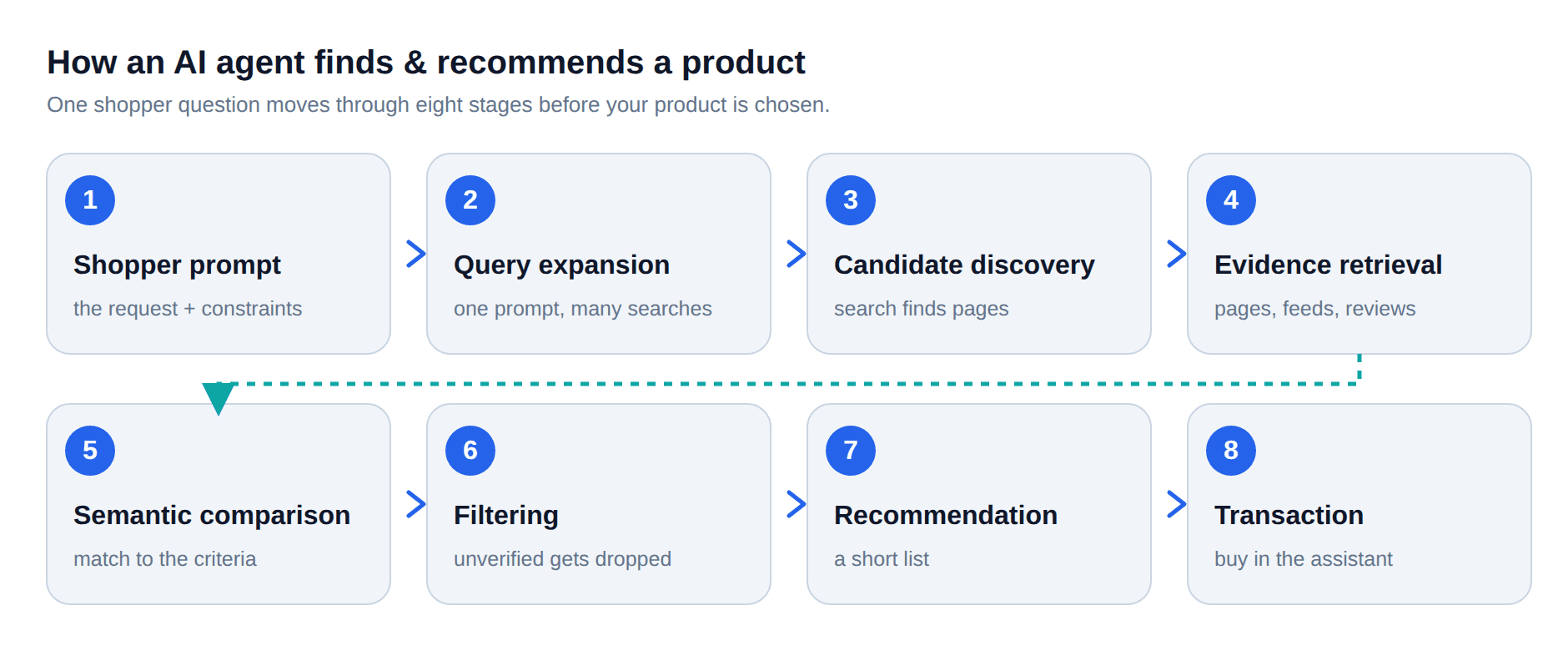
Each stage matters.
1. The shopper's prompt becomes a search strategy
A shopper does not usually type a traditional keyword such as "kids soccer cleats." They ask something much richer: "What are good pink soccer cleats for an 8-year-old beginner that are comfortable, work on firm ground and cost less than $40?"
The AI first interprets the intent and constraints, then runs its own web searches. Google calls this query fan-out: it breaks a complex question into subtopics, issues multiple related searches at once, and fetches additional results to address the query.
Instead of one keyword, the original shopping prompt might trigger searches conceptually similar to:
best youth firm ground soccer cleats under $40
comfortable soccer cleats kids beginner
pink youth FG soccer cleats
best inexpensive kids soccer cleats reviews
youth soccer cleats size 2 firm ground
This is an important shift. Brands are no longer optimizing only for the exact words shoppers type. They are competing for visibility across the searches AI generates from the shopper's intent.
2. Search still determines much of the initial candidate set
This is where traditional SEO remains extremely important. Google has been unusually explicit: its generative AI features in Search are rooted in its core Search ranking and quality systems, highlight content from the Search index, and review information from the retrieved pages to build AI responses.
So the assumption that "SEO is dead because shoppers use AI" is backwards. In many AI experiences, SEO becomes an upstream input into AI recommendation. If your product, category page, buying guide or supporting content cannot be crawled, indexed and retrieved for the searches the AI generates, the model may never get the chance to evaluate it.
Traditional fundamentals therefore continue to matter:
crawlability
indexability
canonical URLs
internal linking
page titles and headings
relevant page content
site authority and helpful content
category architecture
freshness
technical performance
Google specifically says the same foundational SEO practices continue to apply to its generative AI features. In its own words, AI search is still search.
3. Structured product data helps the search layer understand what you sell
SEO helps the page enter the search ecosystem. Structured data helps search engines understand the product facts on that page. For eCommerce brands, Product and ProductGroup structured data can communicate:
product identity
brand
SKU
GTIN or UPC
variants
price and currency
availability
ratings
shipping information
return policies
Google uses Product and ProductGroup structured data to show richer product results, including price, availability, review ratings and shipping. Structured data is not required for AI features, and Google says it is a good idea to keep using it. It is not a magic ranking signal; it simply gives search and commerce systems a clean, machine-readable version of your product truth.
The more useful way to think about it: JSON-LD creates a clean, machine-readable representation of product truth that strengthens the search and commerce data ecosystem feeding AI discovery. And critically, the structured data should agree with what is visibly presented on the page. An AI system should not have to decide whether the HTML says one price, the JSON-LD says another, and a merchant feed contains a third.
4. The AI builds an evidence set
Finding the product is only the first hurdle. The AI next needs enough information to decide whether the product actually deserves to be recommended. In a web-grounded AI experience, search results help determine which pages and sources are worth retrieving in greater detail. Those sources can include:
your product page
your category pages
your buying guides
competitor product pages
retail marketplaces
product reviews
publisher articles
forums and Reddit discussions
manufacturer documentation
merchant feeds and shopping databases
The pages ultimately surfaced as citations provide a useful window into the evidence set the AI considered. Perplexity searches the web and links its sources, and tells site owners to allow PerplexityBot so pages can be surfaced. ChatGPT surfaces websites through OAI-SearchBot, which OpenAI recommends allowing in robots.txt.
This means an important GEO metric is not simply "Did my domain appear in the answer?" It is also "Did my brand or product enter the AI's source and evidence set?" A competitor may win the recommendation because its product page was retrieved, or because Wirecutter, Reddit, a retailer and three review sites all provided strong supporting evidence for it.
5. The AI retrieves the information it needs to evaluate the candidates
Once candidate sources are identified, the system can retrieve page content and structured information to answer the shopper's question. For websites, that may include:
visible page copy
specification tables
headings and FAQs
reviews
HTML and structured data
accessible DOM content
images
supporting articles and policy pages
Other commerce sources can supplement the web. ChatGPT shopping, for example, uses structured product metadata from first-party and third-party providers in addition to the public web. Shopify merchants are already represented through Shopify Catalog, and OpenAI supports merchant product feeds and ACP-based product discovery.
So modern AI product discovery increasingly has two complementary paths: search and public-web retrieval, and structured commerce or catalog data. Strong brands should prepare for both.
6. The AI compares products semantically against the shopper's criteria
This is where AI shopping diverges most dramatically from classic search. A search engine historically ranked pages. A shopping agent can evaluate products.
Consider the prompt: "Best carry-on backpack under $150 for a 5-day Europe trip that fits under most airline seats and has a laptop compartment." The model can decompose that request into requirements such as:
Product type: backpack
Price: less than $150
Use case: multi-day travel
Size: airline friendly
Storage: laptop compartment
Preference: likely lightweight and comfortable
It can then evaluate competing products based on how much reliable information it can find for each criterion. This creates a critical distinction: having the information somewhere on your website is not the same as making the product easy to evaluate against a buying criterion.
"Engineered for modern travelers" tells the AI very little. "18 x 13 x 7 inches; fits beneath most U.S. domestic airline seats; padded 16-inch laptop compartment; 28-liter capacity" gives the AI evidence it can actually use. The brands that make product fit explicit have an advantage over brands that rely primarily on marketing language.
7. The AI filters candidates
Products can be eliminated before final ranking. If the shopper asks for something under $100, available in size 8, vegan, dishwasher safe, compatible with an iPhone, suitable for sensitive skin, or deliverable by Friday, and the AI cannot verify that requirement, the product may simply disappear from consideration.
Missing information can therefore behave like a negative signal even when the product technically qualifies. The product may satisfy the requirement, but if the AI cannot prove it, the result can be the same as if it did not.
8. The remaining products are ranked against each other
The final decision is comparative. ChatGPT says its shopping results consider your query and context, price, reviews and ease of use, and that when choosing a merchant it also weighs availability, price, quality and whether they are the maker or primary seller. It also says these product results are selected independently and are not ads.
This means there is no absolute definition of "AI optimized." Your product does not need to achieve a theoretical perfect score. It needs to present stronger, more reliable evidence for the shopper's needs than the alternatives the AI discovers. That is why competitive benchmarking is fundamental to GEO.
Why Prompt Testing Must Use Live Search
This is one of the most important mistakes brands make when measuring AI visibility. They send prompts to an LLM without web search and assume the result represents what a consumer would see. It does not.
A model answering only from its pretrained knowledge is primarily measuring: what does the model already remember about my brand? A consumer using ChatGPT Search, Perplexity or Google AI Mode is testing something different: what can the AI discover and verify about my brand right now?
ChatGPT can search automatically when a question benefits from current information, while Perplexity describes its answers as using real-time web search. Shopping queries are especially sensitive to current information because prices change, inventory changes, new products launch, reviews accumulate, competitor pages improve, merchant feeds change and search rankings move.
Testing agentic commerce readiness therefore requires testing the search-enabled shopper experience, not merely the underlying language model. A proper benchmark should record more than the final answer. It should capture:
the shopper prompt
the engine tested
search-enabled versus model-only mode
the products surfaced
recommendation position
citations and source domains
pages retrieved
product attributes recognized
price and availability accuracy
competitors recommended and the reasons they won
incorrect claims or missing information
Run the same intent repeatedly, because AI answers are probabilistic. The objective is not to win one screenshot. It is to improve your probability of discovery and recommendation across a representative set of shopper intents.
The Agentic Commerce Readiness Process
Agentic commerce readiness should be treated as a continuous optimization process rather than a one-time technical audit.
Step 1: Understand real shopper intent
Start with the questions customers actually ask. Traditional SEO research often begins with keywords. AI commerce research should begin with shopping intents and constraints. Examples include:
best affordable soccer cleats for kids
running shoe for flat feet under $120
gold necklace that won't tarnish
quiet dishwasher for an open-plan kitchen
sofa for a small apartment under 80 inches
vitamin C serum for sensitive skin
These prompts contain the attributes that ultimately drive recommendation. A useful prompt corpus should cover category discovery, use cases, budget, attributes, comparisons, problems, compatibility, audience, occasion and purchase constraints. That becomes the demand model against which your catalog is tested.
Step 2: Establish the AI visibility baseline
Run those prompts across the AI engines your customers use. For each test, identify:
Does the brand appear?
Does the product appear?
Which competitors appear?
Where does the product rank?
Which websites are cited?
What product facts does the engine know?
Which facts are wrong?
Why does the AI prefer another product?
This establishes your current AI Shelf position.
Step 3: Diagnose the retrieval layer
If your product never appears, do not immediately start rewriting the PDP. First determine whether the AI can find it. Inspect:
search index visibility
canonical URLs
robots directives and crawler access
XML sitemaps
page rendering
internal links and category coverage
titles and headings
duplicate URLs
JavaScript-rendered product information
Search Console visibility
AI crawler accessibility where applicable
A product cannot be recommended if it never enters the candidate set.
Step 4: Build a complete product truth layer
Next determine whether machines can clearly understand the product. Your product page, structured data and commerce feeds should agree on the core facts. For large catalogs this becomes a product data management problem as much as a content problem.
Important attributes should include the identifiers and characteristics relevant to the category, not simply the minimum fields required by a commerce platform. For footwear that might include surface type, age group, size system, upper material and closure. For furniture it might include dimensions, materials, seating capacity, assembly and room suitability. For skincare it might include ingredients, concentration, skin type, fragrance status and usage guidance. The richer the verified product truth, the more shopper criteria the AI can confidently evaluate.
Step 5: Improve the semantic evidence on the product page
Structured data tells machines what the product is. Page content should explain why it is appropriate for the shopper. A strong AI-ready PDP should make important buying criteria explicit. Instead of "Premium comfort for everyday play," prefer information such as:
Lightweight synthetic upper designed for recreational and youth players
Padded heel collar reduces rubbing during extended play
Firm-ground molded studs designed for natural-grass fields
Available in youth sizes 8C through 6Y
The objective is not keyword stuffing. It is reducing ambiguity. The AI should be able to answer: who is this for? What problem does it solve? When should someone choose it, and when should they not? What makes it different, and which specifications prove those claims?
Step 6: Build brand-level trust and context
A product rarely exists in isolation. AI systems also encounter information about the company behind it. Brands should maintain clear, crawlable information explaining:
who the company is and what it specializes in
target customer
product quality
warranty
shipping and returns
customer support
sustainability claims and certifications
company history where relevant
These facts help the AI understand whether the merchant and brand are credible. Third-party evidence matters as well: reviews, retailers, independent publishers, industry sources, communities and customer discussions all become part of the public evidence the AI can use.
Step 7: Connect the commerce data layer
Do not rely solely on webpages. Maintain high-quality feeds and product integrations wherever relevant. Google Merchant Center, Shopify's commerce ecosystem, ChatGPT product discovery integrations and emerging protocols such as ACP and UCP increasingly give agents access to structured, fresher commerce data. ChatGPT already uses merchant and third-party structured product metadata and integrates Shopify Catalog into product discovery. This becomes particularly important for information that changes frequently:
price
availability
variants
promotions
shipping
seller identity
checkout availability
Step 8: Make the purchase path agent-friendly
Discovery is only half of agentic commerce. Agents increasingly perform actions. The website should make it easy for both humans and browser-based agents to understand product selection, variant selection, inventory, price, shipping, returns, cart state and checkout actions.
Google notes that browser agents may inspect visual rendering, the DOM and the accessibility tree when interacting with websites. Clear HTML, accessible controls, stable identifiers and predictable commerce workflows therefore become increasingly important. Emerging transaction protocols provide another path where agents can interact directly with merchant systems rather than operating the browser.
Step 9: Re-test against the competitors that actually win
After improving pages and product data, rerun the original prompts. But do not evaluate the brand in isolation. Compare your content, structured data, product attributes, citations, third-party authority, pricing, reviews and merchant data against the products the AI actually recommends.

This is the most important principle in agentic commerce optimization: you compete against the evidence available for your competitors, not against an abstract best-practice checklist. If a competitor has twenty clearly documented buying attributes and you have eight, that matters. If multiple independent sources describe the competitor as excellent for a particular use case while your product makes the same claim only on its own PDP, that matters. If their price and inventory are synchronized across search, merchant feeds and marketplaces while yours conflict, that matters. AI recommendation is comparative. Your optimization process should be as well.
Agentic Commerce Readiness Checklist
A brand preparing for AI-driven shopping should continuously validate the following:
Discovery: important PDPs and category pages are crawlable, indexable, canonical and internally linked.
SEO relevance: titles, headings and content clearly communicate category, product type and meaningful shopper intent.
Structured data: Product/ProductGroup markup accurately contains identifiers, offers, variants, price, availability and applicable commerce attributes.
Data consistency: visible page content, JSON-LD, merchant feeds and marketplace information agree.
Product identity: brand, SKU, MPN, GTIN/UPC and variant relationships are clearly represented where applicable.
Attribute completeness: important category-specific specifications are explicit rather than implied.
Intent coverage: page content addresses audience, use cases, constraints, benefits and purchase considerations.
Evidence quality: claims are specific, factual and supportable instead of vague marketing language.
FAQs: real purchase questions are answered directly where they add value.
Comparability: dimensions, materials, compatibility, sizing, ingredients and performance can be compared easily against competing products.
Freshness: prices, inventory, promotions and product changes propagate quickly to pages and feeds.
Merchant feeds: Google, Shopify and applicable AI-commerce feeds contain complete, accurate product information.
Brand context: About, shipping, returns, warranty, contact and policy information are easy to find and understand.
Third-party trust: independent reviews, publishers, retailers and communities corroborate the brand and products.
Images: important product images are indexable, descriptive and tied clearly to the correct product and variant.
Agent usability: product selectors, forms, cart actions and checkout controls are accessible and predictable.
Transaction readiness: agents can reliably determine price, stock, seller and path to purchase.
Prompt benchmarking: testing uses real shopper-intent prompts with live search or the engine's native shopping experience enabled.
Citation tracking: the domains and pages AI systems use as evidence are monitored.
Competitive benchmarking: recommended competitor products are analyzed for content and data advantages.
Recommendation measurement: share of visibility, citation, recommendation position and product selection are tracked over time.
Attribution: AI-driven referrals and AI-attributed revenue are separated from traditional organic and direct traffic where possible.
The Real Goal: Become Easy for AI to Defend
AI systems do not simply need to know that your product exists. They need enough reliable evidence to justify recommending it. That changes the optimization target. A strong agentic-commerce presence makes the product easy to defend across seven dimensions:
Discoverable: search and commerce systems can find it.
Understandable: the product's identity, attributes and use cases are explicit.
Citable: reliable pages and sources provide evidence about it.
Comparable: the AI can confidently evaluate it against competing products.
Trustworthy: claims, reviews, policies, pricing and public information are consistent.
Selectable: the product satisfies the shopper's intent better than the alternatives.
Transactional: the shopper or agent can reliably complete the purchase.
This is the new competitive surface. The winner is not necessarily the brand with the longest product description, the most schema markup or the most backlinks. It is the brand that gives AI systems the strongest combination of retrievability, product truth, semantic relevance, public evidence, trust, freshness and transaction readiness for the shopper's specific intent.
And because every recommendation happens relative to the alternatives available at that moment, agentic commerce readiness is never finished. You test. You see what the AI discovers. You understand why competitors win. You improve the evidence. You publish. And you test again.
That is how brands move from merely being indexed to being chosen.
Sources
Google, Optimizing for generative AI features on Google Search
OpenAI, Overview of OpenAI crawlers
OpenAI, Shopping with ChatGPT search
Perplexity, Perplexity crawlers
Agentic Commerce Protocol (ACP), the open standard maintained by OpenAI and Stripe
Want to see how ready your product pages are for AI shopping agents? Run them through Banavo's PDP readiness checker at banavo.ai/pdp-readiness.