/
/
48% of Shopify Product Pages Are Ready for AI Visibility — but Only 3% Have Context for AI Recommendation: Inside Our 10,000-PDP Benchmark Across 2,000 Brands

AI assistants are becoming the front door to eCommerce. When a shopper asks ChatGPT, Gemini or Perplexity for "the best waterproof running jacket under $150," the assistant searches the web, reads product pages, compares options, filters out anything it can't verify, and recommends a short list. The product it can't understand never makes that list.
So we asked a simple question: how many product pages are actually ready to be understood, evaluated and recommended by an AI shopping agent today?
To find out, we ran 10,000 product description pages (PDPs) across 2,004 eCommerce domains running Shopify through Banavo's AI-shopping-readiness gate. Of those, 9,969 pages across 2,000 domains fetched successfully and could be scored.
The headline result: only 48.4% of successfully fetched PDPs met our minimum AI-shopping-readiness standard for visibility while only 3% met the standard for recommendation. More than half of the product pages we tested fell short of the bar an AI agent needs just to consider a product with confidence — before any question of ranking, richness or winning the recommendation.

This is the first in a series unpacking what the benchmark revealed. The short version is that AI readiness is not what most brands assume it is. It isn't a function of how big you are or how large your catalog is. It's a function of how your product data is implemented — and where it breaks is surprisingly consistent.
What "AI-shopping-ready" actually means
Before the numbers, the definition. Passing our readiness gate does not mean a product is fully optimized for AI shopping. It means the page clears a minimum foundation an AI system needs to reliably identify a product and reason about it as something purchasable. A page passes only if it exposes all of the following in a clean, machine-readable way:
Product JSON-LD — structured data declaring the page as a product (C1)
A valid product type — a Product or ProductGroup declaration (C2)
A canonical URL — one authoritative address for the page (C6)
A structured product identifier — a SKU, MPN or GTIN exposed in the structured data (C16)
Availability — machine-readable stock status (C18)
Pricing — a price and currency the AI can read
None of these are exotic. They are the commerce equivalent of a nutrition label: the basic, verifiable facts a machine needs before it will trust and recommend a product. A page can look perfect to a human shopper and still fail, because the information a person reads off the layout isn't exposed in a form a machine can parse without guessing.
With that framing, here is what the benchmark showed.
Readiness varies by vertical — Home leads, Apparel lags
Readiness was not evenly distributed across categories. Home came out strongest; Apparel — despite being the single largest category in the sample — came out weakest.
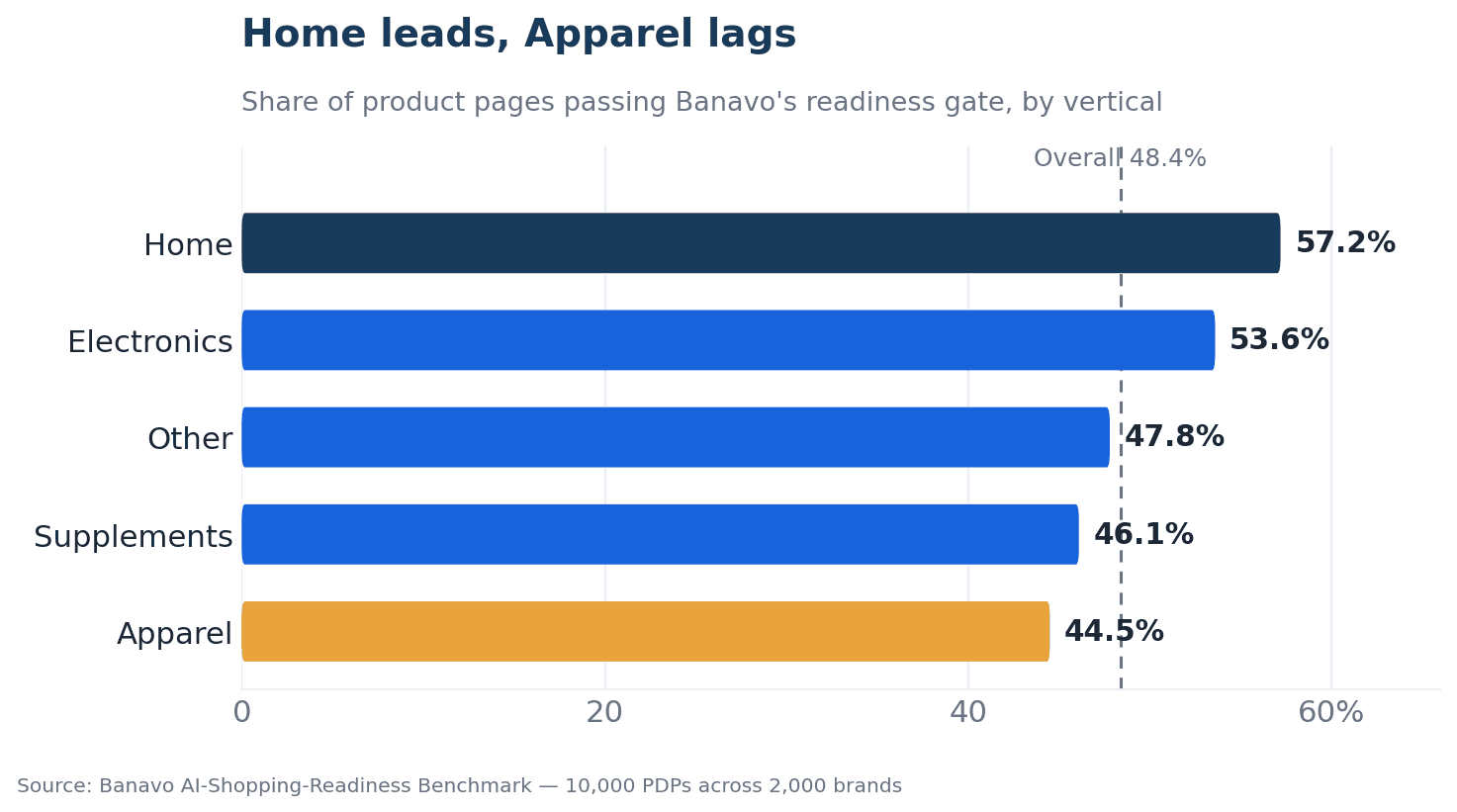
Home PDPs were roughly 13 percentage points more likely than Apparel PDPs to clear the gate: 57.2% versus 44.5%. Given that Apparel makes up nearly a quarter of the entire sample, that gap matters.
The interesting part is why Apparel lags — because it isn't a lack of structured data. Apparel pages actually carry product schema, type declarations, canonical URLs, availability and pricing at rates comparable to other verticals. Where they fall down is product identity.

Apparel isn't missing schema. It's missing a machine-readable way to say which specific product this is. That single weakness — the identifier — turns out to be the story of the entire benchmark.
Nearly half of failing pages are one field away from passing
This is the most operationally useful finding in the dataset. Of the 5,144 successfully fetched PDPs that failed the gate, 2,477 — 48.2% — failed on one requirement only: the structured product identifier (C16). They passed everything else.
Put differently: 1 in 4 of every product page we tested (24.8%) would clear our minimum AI-shopping-readiness gate if the structured product identifier were the only thing fixed. Not a redesign. Not a re-platform. One field, exposed correctly in structured data.
The pattern is even sharper in the categories that struggle most. Among non-ready Apparel PDPs, 612 of 1,119 — 54.7% — failed only on the identifier. Supplements showed almost the same shape, at 53.8%. More than half of failing pages in these categories are otherwise ready and held back by a single machine-readable field.
A structured product identifier — a SKU, MPN or, ideally, a GTIN — is how an AI system tells your product apart from a near-identical listing on a marketplace, a competitor's page, or a review site. Without it, the agent can see that a product exists but can't confidently match it across sources or carry it cleanly into a recommendation. It's the difference between "a blue running jacket" and "this blue running jacket."
Two very different kinds of failure
Not every failing page is one fix away, though. The failure distribution is strikingly polarized. Among the 5,144 failed PDPs, 52.7% miss only one requirement — but a large second population misses five or six.

The most common exact failure patterns make the split obvious: 2,477 pages fail on the identifier alone, while 1,186 fail a bundle of five requirements at once and 363 fail all six.
There are effectively two populations here. One is "almost ready," usually missing just an identifier. The other has fundamentally incomplete product structured data. These are not the same problem, and they don't have the same fix — the first is a targeted data correction, the second is a rebuild of the product-data layer. Knowing which population a store falls into is the difference between a quick win and a project.
It's not a size problem — for company or catalog
Here's the finding that reframes the whole conversation. There's an intuitive assumption that bigger brands, or brands with bigger catalogs, are more likely to have their AI-readiness house in order. Across 2,000 stores, the data doesn't support that.
At the store level, the relationship between reported catalog size and readiness is essentially nonexistent (Spearman ρ = 0.032). The same is true for company revenue (ρ = -0.015). Both are, statistically speaking, flat.

If anything, the largest-catalog quartile scored slightly higher — the opposite of the "big catalogs are messier" assumption. We wouldn't claim large catalogs are inherently better; there are confounders, and these correlations are rank-based rather than tied to precise dollar figures. But the conclusion holds comfortably at this sample size: AI-shopping readiness was not meaningfully correlated with catalog size or company revenue. Being a bigger brand didn't make a store more ready.
(One data note in the interest of transparency: we relied on rank-based correlations rather than published revenue bands, because the revenue-bucket field in the underlying data was inconsistent with the raw values. Rank ordering is unaffected by that, which is why we're comfortable with the correlation result while leaving dollar ranges out of this report.)
Readiness is a storefront trait, not a per-product one
If it isn't about size, what is it about? The store-level consistency data points straight at implementation. Across the 2,000 stores, 733 (36.7%) had every sampled PDP pass, 851 (42.6%) had zero pass, and only 416 (20.8%) had mixed results.

In other words, 79.2% of stores were internally consistent — either uniformly ready or uniformly not-ready across every product page we sampled. Readiness rarely varies product to product within a store. It's inherited from the theme, the schema implementation, the platform configuration and the product-data pipeline that generates every PDP.
That's why AI readiness behaves like an implementation problem rather than a per-product optimization problem. You don't fix it by hand-editing 10,000 product pages. You fix it once, at the layer that produces them — and every page moves together.
Enterprise infrastructure doesn't solve it either
The same theme shows up in platform data. Moving upmarket on Shopify didn't correspond to materially better readiness.

Shopify and Shopify Plus land within a point of each other. We're not saying Plus doesn't help — there are selection and implementation differences between these merchants, and the Hydrogen group (18 stores) is far too small to generalize from. The defensible takeaway is narrower and, we think, more useful: enterprise ecommerce infrastructure alone doesn't guarantee AI-ready product data. Readiness is something you implement, not something you buy your way into.
Geography: real differences, but treat them as exploratory
Readiness varied by country, though we'd read these as observations from our sample rather than statements about national eCommerce maturity — country is entangled with which merchants, platforms and verticals happened to land in the sample.

The most robust comparison, on sample size, is UK versus US: UK PDPs passed at 52.0% against 48.8% for the US. It's a real difference, but not large enough to make geography the centerpiece of the story. (Some smaller markets scored much higher — Mexico at 87.3%, for instance — but on only 11 stores, so we're keeping those exploratory.)
Passing the gate is only the starting line
Here's the finding that should temper any celebration among the stores that did pass: clearing the minimum readiness bar is a long way from being richly optimized for AI shopping. Among the PDPs that passed our gate, the deeper commerce signals an agent uses to compare and defend a product were mostly absent.
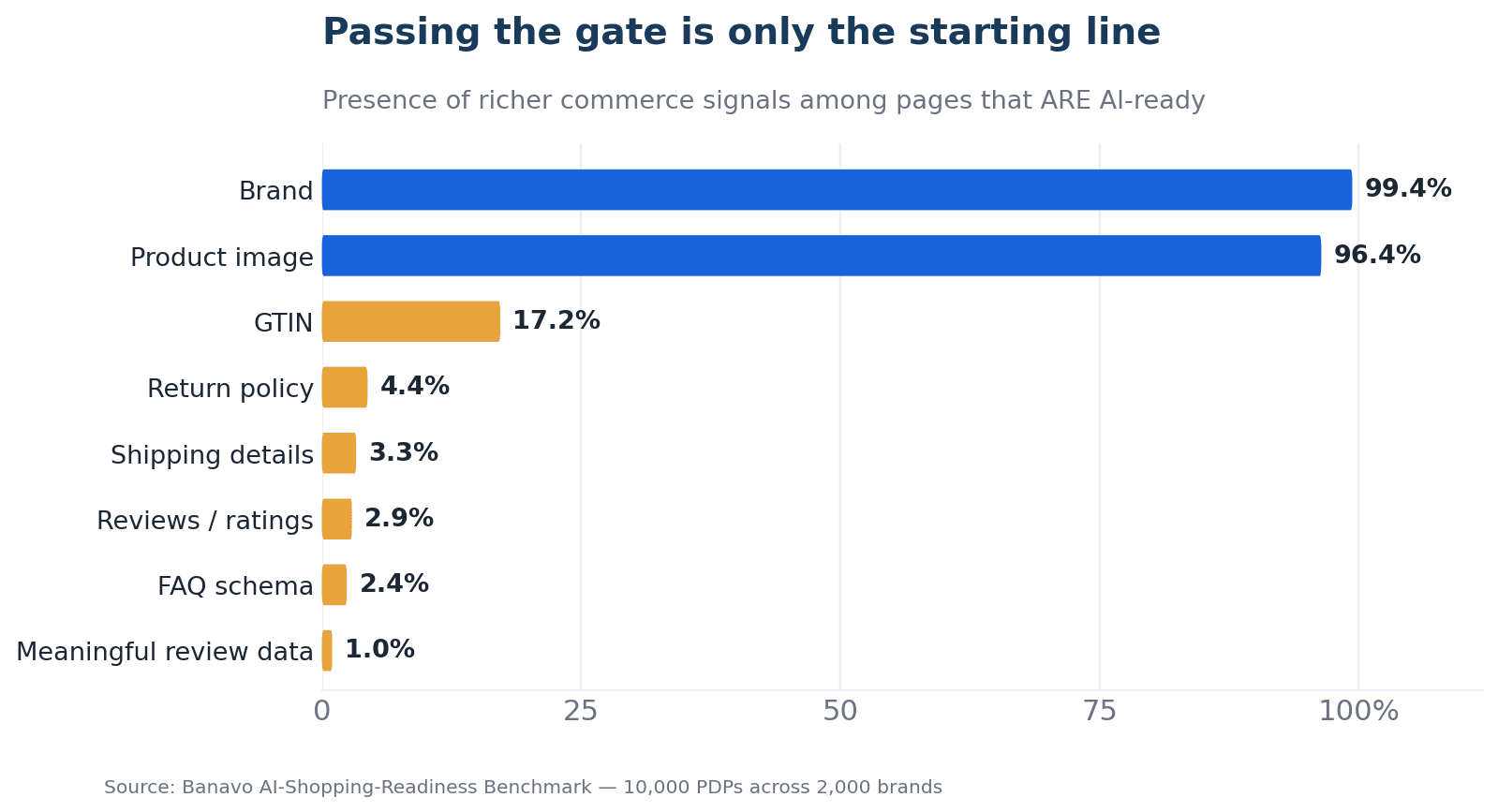
Even among the "ready" pages:
83% still lacked a GTIN (our gate accepts a SKU or MPN, so a page can pass without one — but GTINs are what let an agent unambiguously match a product across merchants and data sources)
More than 95% lacked structured shipping and return-policy information
Only 2.9% exposed structured review or rating data
These are arguably more revealing than the headline number, because they're independent of how we defined the gate. They show that "AI-ready" and "AI-optimized" are two different things. Readiness gets you into consideration. Richness — the shipping, returns, reviews, identifiers and specifications an agent needs to choose your product over a competitor's — is what wins the recommendation. Almost nobody has built the second layer yet.
The GTIN blind spot
Widening the lens beyond ready pages to the entire sample, GTIN coverage is strikingly low across the board — just 8.6% of all successfully fetched PDPs exposed one.

Fewer than 5% of Apparel PDPs exposed a GTIN through the measured signal. As agentic commerce matures and AI systems try to reconcile the same product across your site, marketplaces, feeds and review sources, the globally standardized identifier is exactly the signal that removes ambiguity. Right now, over 90% of product pages don't provide it.
The basics are common; the context is not
Zooming all the way out to the full sample, one pattern ties everything together. Sites are reasonably good at exposing the basics that search needs, and far less consistent at exposing the context AI shopping systems need to reason about a product.

The drop-off is dramatic. Three-quarters of pages expose price and availability; fewer than 4% expose structured returns, shipping or review data. The web is optimized for "can a search engine find this page?" It is not yet optimized for "can an AI agent gather enough evidence to recommend this product over the alternatives?"
What the benchmark tells us
Put the pieces together and a clear thesis emerges:
AI-shopping readiness isn't about brand size, catalog size or having an enterprise plan. It's about whether your product-data layer exposes the right machine-readable information — consistently, across every page.
Three unusually clean pieces of evidence support that:
Company revenue has essentially zero correlation with readiness (ρ = -0.015).
Catalog size has essentially zero correlation with readiness (ρ = 0.032).
Nearly 4 in 5 stores are either entirely ready or entirely not-ready across their pages — readiness is a storefront trait.
Then the mechanism: product identity is the single biggest bottleneck. Nearly half of failing pages were otherwise ready and missing only a structured identifier — a fixable, template-level problem, not a per-product one.
And the frontier: even ready pages are thin. Shipping, returns, reviews and globally standardized identifiers are almost universally absent, which means the gap between minimum readiness and true AI optimization is wide open for the brands that move first.
If your PDPs are among the 51.6% that fall short, the good news is that the most common failure is also the most fixable. And if they already pass, the benchmark is a reminder that the bar is about to rise — being found by an agent is table stakes; being chosen by one is the game. We will explore the details how to get chosen in the next series, stay tuned.
Want to see where your product pages stand? Run them through Banavo's PDP readiness checker at banavo.ai/pdp-readiness to find out which of your PDPs are AI-shopping-ready — and which are one field away.
About the benchmark: Findings are based on 10,000 product description pages sampled across 2,004 eCommerce domains running Shopify, of which 9,969 pages across 2,000 domains fetched successfully and were scored against Banavo's AI-shopping-readiness gate (Product JSON-LD, product type, canonical URL, structured product identifier, availability and pricing). Correlations are rank-based (Spearman). Country- and platform-level figures with small sample sizes are noted as exploratory.